Showing posts with label food science. Show all posts

Wednesday, 16 June 2010

Everything but the squeak, a tribute to Denham pork

From doodle to degustation

Earlier in the week you saw the scribble as we planned a dish I have had in mind for some time.

Even then it rarely makes it to the plate quite like that

Any way with porky bits cooked and raring for action, off we went


From front to back
pork loin studded with truffle
slow braised pork belly (60 hours sous vide)
black pudding
pigs head terrine, crumbed with crude pork crust
pork tenderloin roasted
pigs ear again pork crust coated

To this we added a small amount of pea puree, feves, split beans and peas

a slim Anna potato, some pea shoots a drizzle of pork jus and we are ready to serve


almost as sketched, beautiful plate of textures and tastes, a real celebration of one of the best farms in England Denham Estates

Also this week a coupl of dishes we have running are a simple chicken and peach salad with almonds, a small toast to benzaldehyde


And simple plaice and asparagus, which a few fillets are 'glued' together with Activa, then simply breaded and fried, with asparagus, remoulade and a parsley beurre noisette the reason for glueing is to give the piece of fish more substance and to retain more moisture to improve the eating quality


Also thought I would pop in this week's best seller though, being a club a lot of our membership are traditionalists and love the following dish, I don't believe I will ever be able to remove from the menu, and why not everyone loves a good calves liver and bacon, we serve ours simply on a bed of sage crushed potato and a little onion gravy.


Menu changes again on the 28th (or there abouts), should have more menu gems for you then, next I am hoping to show off a few little gems in my garden, providing the kids haven't been foraging too much.

Time for lunch methinks with Chef1 from The Staff Canteen


Friday, 16 April 2010

Menu change, 16th April 2010 a new blog item

I was thinking today about what to write about next, have had fun lately with some nice ideas translating into some equally nice dishes, however as you may be aware these can be sometimes spread apart, but I tweak my menu weekly generally, and we photograph EVERYTHING, much to our waiting staffs annoyance, they have to wait around whilst 3 chefs get cameras and phones out to catalogue our dishes.

So I though I would include a somewhat regular slot of some of the more interesting tweaks we do to our menu as and when it happens, not every change though as sometimes the dishes are quite simple, or we simply do not have the time to take any decent photographs.

Lets start with 'Coquille Saint Jaques'
my commmis Tom has been running away with dish ideas over the last few months with a great emphasis on foaming and jellying and losing touch with the basics that make a dish great, so I set him the challenge of recreating this classic dish. I was first concerned that I hadn't shortened the leash enough when I started seeing tuilles being made out of breadcrumbs and balls ready for spherification in his mis-en-place.

Thankfully on this occasion he pulled it off and the dish is pretty as a picture and eating quality is excellent

scallop, button mushroom, duchesse potato, bread tuille, vin blanc spherification
the sphere itself is great fun, just warm enough to burst on the plate with just the right amount of sauce, the lemon puree adds acidity against the vin blanc and the duchesse.

the spheres waiting for an order


up close and personal

Next, I gave Ricardo, my sous chef, a similar goal to recreate something a little more classical and he chose a traditional portugese meat platter, translating this down was quite a task but, like Tom, pulled off only what can be described as a fantastic dish, has everything going for it, balance of flavour, texture and whilst it is a handsome portion, still leaves you wanting more at the end of it. Well done.


Poached chicken
sausage meat with choizo and black pudding
crisp pig ear
beef fillet
carrot puree
potato
turnip
chorizo oil
(and missing from this shot) Savoy cabbage
drizzle of jus and micro parsley

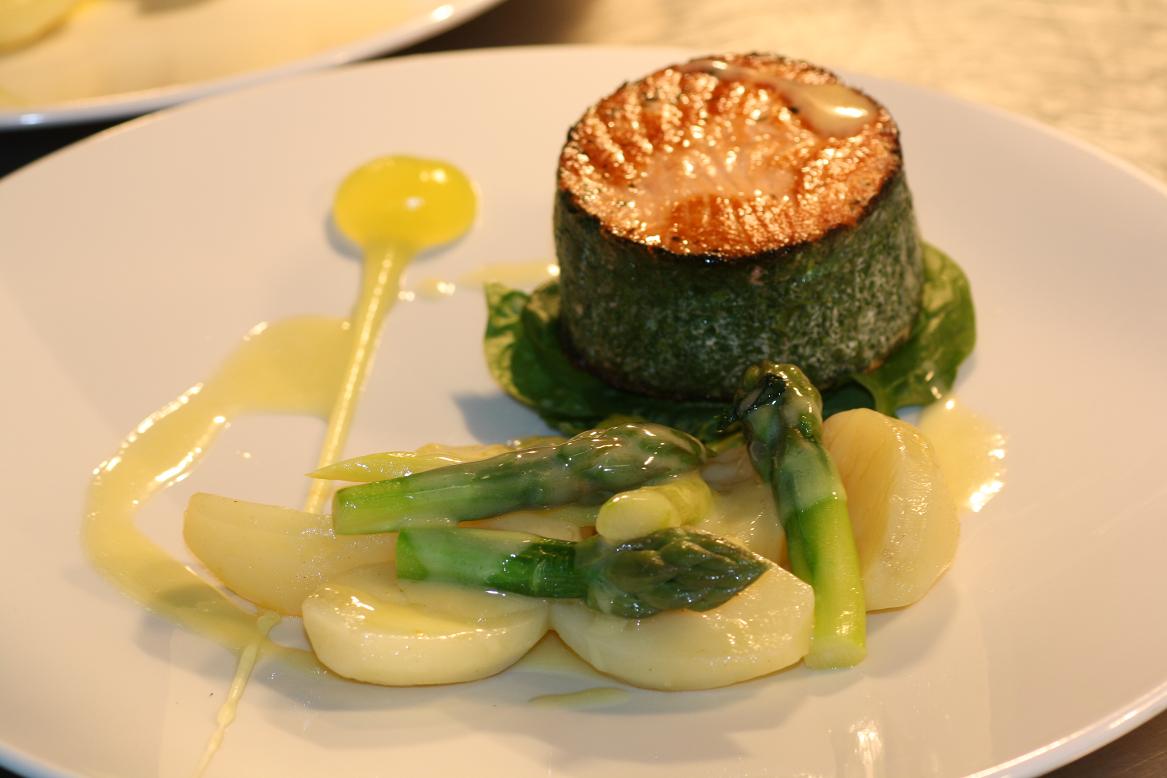
Herb wrapped balotine of salmon, wye valley asparagus, new potatoes

does exactly what it says on the box, the only tweak is glueing the salmon together with activa, other than that it is designed to show off new season English asparagus (and from Monday, Jersey royals) to their very best, simplicity is key to this dish.


Sea bream, fricasse of vegetables, sweetcorn veloute, popcorn cream and chicken popcorn

The bream is simply steamed, vegetables warmed in the veloute then a splash of popcorn bubbles and for texture a few pieces of popping corn I have popped in chicken fat and seasoned whilst hot. straightforward and nice and light for this lovely weather.


Last (but in no way least) G has produced ANOTHER Rhubarb and custard variation, the versatility of this combination and how it can be presented is incredible. With this incarnation he has introduced a little bitterness in the form of a yogurt coral cake and yogurt ice cream. Oldie but goldie and our guest do not tire of it any more than we do not tire of showing off this great combination in anyway our imagination takes us.


Anyway, hope this will help keep this blog more interesting to read, we will continue with the random other things we post about, but this should lessen the occasional drought of posts that we are guilty of having more than we really should.

Thanks to the guys this week for making my life much easier by coming up with such great dishes.

Tuesday, 30 March 2010

Chicken ballotine, wild mushroom fricasee and foie gras jelly

And the jelly from the previous post is used for...


Ballotine, stuffed with mushrooms, calves liver and spinach
agar triangle of mushroom fricasse
caramelized foie gras jelly
foie gras 'tapioca' rocks
parsley

Wednesday, 20 January 2010

Guest piece on Herve This by Peter Crosskey

Well G has stolen my thunder, for a few days have been thinking to wake the blog up after an extended break, and log in today to find our first post of the year, ah well the hydrocolloid thing is nice to look at and playing is much easier now.

A short while ago after joining the UK food bloggers association I was emailed by Peter Crosskey who showed an interest in this post on alternative fish preparation. we got chatting about modern techniques and I found he had recently attended a lecture by the almost legendary Herve This.


I was far too jealous before I read the piece below which he has produced for this blog, and even more after! Any way, without any further ado I hand the floor, nay the screen, to Peter, many thanks for writing this.


The scientist who gets a cubic metre out of one egg white

Fresh from the Eurostar, Hervé This was in his element when he arrived at Imperial College to address a lecture hall full of chemical engineering students in London on November 30 last. With a twinkle in his eye and a playful smile that flitted across his lips between sentences, he was fulfilling his vocation: sharing his knowledge of the science that underpins cooking.

The co-founder of molecular gastronomy wears the weight of his learning lightly: March 2010 will see the 30th anniversary of a sunken soufflé. It was this which propelled Hervé to map out the scientific principles that underpin what happens in the kitchen.

He opens with an obligatory PowerPoint slide to introduce himself. Then he announces that on the train here he changed his mind about what he was going to do in this lecture.

"Let us make a simple experiment," he exclaims, much as his late colleague Nicholas Kurti would have done all those years ago when no-one had heard of molecular gastronomy. His approach is direct and engaging: he takes an egg out of its box and separates the white into a bowl.

"You say 'egg white' and yet it is yellow," he observes as he works. "But don't worry: in France we make the same mistake, too." He explains that there are about 30 grams of egg white in the bowl and that 90% of it is water.

"When the water is taken out, you are left with about 3 grams of protein – and it is yellow!" he exclaims, pulling out of his pocket a glass phial of dried egg white, like a stage magician. The phial is stowed as rapidly as it appeared and he is holding up two egg whisks: "Which one is better?" he asks, before grasping them both firmly in a single hand and using the two together.

Now an egg whisk is nothing short of "...medieval..." for This, who constantly challenges old ideas. "I hate tradition. Slavery is traditional," he interjects.

What distinguishes humanity from animals is an ability to consciously change the world around us, This argues. The mastery of fire and cooking food gave humans a decisive advantage in a hostile prehistoric world.

Society is constructed by human endeavour, This reminds his audience. "When it is built, it is beautiful," he says, pausing long enough in front of a Powerpoint slide with a restaurant plate shot to make his point.

He has been whisking steadily all the while, so the egg whites are firm now: he inverts the bowl abruptly just to make the point. So far This, who thinks nothing of generating a cubic metre of foam from a single egg white, has added only sugar.

He reaches for a bottle of water: this is his secret weapon that transforms the contents of his three-litre bowl into the magic cubic metre. "Of course it is very difficult to measure a cubic metre of egg foam at all precisely," he adds, returning to the scientific business in hand.

"Now, water has no taste, but you can use green tea, fruit juice, olive oil, anything you want." He crosses the boundaries between science, technology and cooking with ease, but never loses sight of his own role, even when pouring his egg white foam into a beaker and transferring it to a microwave.

"You see, I am a scientist and my job is to create knowledge: technologists use knowledge to make tools like this microwave, while chefs use their skill and equipment to make people happy at the table." He pauses, flings open the microwave door, withdraws the beaker and up-ends it with a vigorous shake, turning out the soft set foam.

He challenges the next generation of scientists to lay the foundations for greater things. He does it with such style and enthusiasm that we are all inspired to return to our laboratories, workshops and kitchens with raised expectations of what can be acheived.

Hervé was in the UK for a two-day whistle-stop tour to promote the English translations of two of his books. Earlier this year, Columbia University Press (CUP) published Building a Meal: From Molecular Gastronomy to Culinary Constructivism, being a translation of his 2007 book Construisons un Repas.

The most recent CUP translation is The Science of the Oven, a translation of his 2007 publication De la Science aux Fourneaux. Intended for a scientific audience, it remains an engaging read for lay readers, shot through with candour and Hervé's gentle humour.

Every month. in addition to contributing to the journal Pour la Science, This writes about a scientific insight for the website of his friend, the chef Pierre Gagnaire ( http://www.pierre-gagnaire.com/ ).

For readers of French, Hervé This has a blog at http://hervethis.blogspot.com/ which is well worth following.

Finally, anyone can sign up for the lectures that Hervé This gives at AgroParisTech ( http://www.agroparistech.fr/-Annonce-Cours-de-gastronomie-.html ). Both the page and the lectures are in French, but the inspiration is universal.
--------------------
About panel:
This post has been contributed by freelance journalist and blogger Peter Crosskey who was fortunate enough to attend a lecture given by distinguished French scientist Hervé This, the surviving co-founder of molecular gastronomy. My thanks go to Alex for letting me submit this article. A more general piece, along with reviews of two English translations of books by Hervé This can be found at:

http://www.crosskey.co.uk/index.php/2009/12/05/science-that-is-good-enough-to-eat/

Tuesday, 27 October 2009

Lamb stock - sous vide the real way forward

"why are stocks simmered for so long?"

"WHAT!"

"err, why are stocks made over days constantly topped up with fresh water?"

"Because they work that way, get on with your mis....!!"

sure that all cooks have has sous that had the stock answer (usually shouted) of "because it does", often accompanied by a swift thwack accross the back of the head, perhaps this is why I grew up in kitchens where questions were seldom asked, for myself I was quicker at ducking than most so asked anyway, also if something didn't make sense then I had to get an answer, even if it was dug up myself.

but one question still has not been answered.

so have stuck to these rules for the last 20 years as I have not known better.

recently the trend has led towards pressure cooking stock, this can lead to outstanding flavour, but also to a heavy gelatinous mass and (once pressure is achieved) loses volume anyway, which could lead to 'topping up' the main issue I have in the whole process. why add fresh water when you are trying to impart as much flavour as possible into the liquid.

which led me to this task:

whilst preparing a petit gigot for this weeks menu, I ended up with an inordinate amount of trim due to the nature of the mis en place, so with the idea at hand, it seemed as good a time as any to try out the thought.

so step 1; traditionally roast the bones in the usual way, rendering as much fat as possible for use later.

here is the fat infusing with orange and rosemary, this will later be used to fry the gigot in for service


Step 2: is to fill large Vac-pac bags with, bones, water, red wine, rosemary, thyme, mirepoix, seal at full pressure and double bag

Step 3: set my Rational oven to 66C and put deep waterbaths in the oven, add the bags and cling film the waterbath to minimise evaporation.

Step 4: go home and have a nice weekend with the family, leaving the stock (and some duck legs for good measure) ticking over for the weekend.

Step 5: 60 hours later, remove the baths from the oven, drain the duck, god what a texture, more on this another day. but eagerly drain the stock bag in anticipation of the contents, first thing to note was the meat was squidging off the bones incredibly but the mirepoix was still firm, so my first thought was, 'bugger no veg flavour' thankfully this was a short lived concern, as the flavour was greatly pronounced.

step 6: chill the stock to remove the last of the residual fat, and found the stock beautifully gelled and clear as a bell (this is where impatience got the better of me and should have agar filtered at this point, but one step at a time). the flavour was like none I had tastede in such a simple stock, deep and meaty but with a fresh sweetness of vegetables and herbs and none of the usual stewy notes of the usual over cooked veg in stock.

step 7: reduction, had to fulfill this with respect. most of our jus at this point gets either wine, or port a little fresh veg perhaps but all get as much gas as I can get underneath it, quick reduction and pass and store, next job.
but not this one. kept the temperature between 75 & 80 (mostly) but never boiling and brought down slowly, slowly heightening flavours and not just evaporating water, trying to maintain the balance of flavour I had in the original stock, also to this stock I added nothing, just time. the end flavour was a depth I have not known in a jus of such basic ingredients, no fancy wines or ports, just a basic stock.


step 8: pass, chill, store. Ready to be served with the Gigot which I will post briefly next time.

Saturday, 5 September 2009

PEAS one of my favourite foods

I quite simply love peas

versatiliy in a small green skin, I can,'t think of a food that will not accept the humble pea as a garnish in one of it's numerous guises. Mushy peas with fish, smooth puree with steaks, plain and simple with butter and mint for lamb, not forgetting soups and sauces, I cannot think of any vegetable that is quite so capable.

here is one of the dishes we did recently


scallop, peas, bacon and whisky sour

The dish concept is as old as the hills but the ways in which we are able to revisit and re-invent it each and every time is usually down to the manipulation of this fantastic bastion of spherical clorophyl.


same dish not so arty

talking of classic combinations, reminds me of something a few weeks ago, hmmm onto the next post. until then a quick recipe for the pea gel sheets

to make 20 sheets


  1. 500gm frozen peas


  2. 300gm  cold water (plus water to boil the peas)


  3. 25gm vegetable gel (sosa brand)


  4. salt

bring the water to the boil, add the peas and cook at a rapid boil for 5-6 minutes, strain the peas and refresh in iced water. blitz in a blender until smooth with the cold water, and pass through a fine sieve, the season to taste with salt only.

using an immersion blender, blend the gel into the cold liquid and then transfer to a pan and bring to the boil as quickly as possible. At 90 degrees C the gel hydrates and is ready to use, pour quickly onto a gastronorm tray and very quickly pour any residual pea liquor off into the pan, you only have seconds to do this as the gel sets almost immediately and can take a little practice.

once the gel has cooled it can be cut to your required size and stored in the fridge, separated by silicone sheets, for up to 3 days. place on plate as required and warm with a blowtorch or salamander as your recipe requires, it is heat resistant up to 82C


cutting the sheet

getting ready to store

Monday, 31 August 2009

'Fillet' steaks my first soap box and some thought

The concept of a fillet has had me thinking for a while, we all know the fillet steak is a cylindrical non working muscle from just within the rib cage of a given animal, sometimes referred to as 'underfillet' or tenderloin. This depends on which animal you are talking about.

but what is with Salmon fillet? an almost cuboid piece of fish, working muscle, although tender doesnt look like fillet to me, also chicken fillet is often referred to in many restaurants accross the land from high cuisine to more questionable fast food outlets undercover of a sesame topped flour 'bun' I use this term loosely as often resembles a happy shopper bathroom sponge. Anyway I digress back to the 'fillet' soapbox'.

soapbox is quite unfair, we are grown ups, and are fully capable of making the distinction of 'fillet' due to our upbringing and learning and also it ticks all the texture boxes, I could ponder now on why every fish there is has a 'fillet' but feel i may be near exhausting this topic.

anyway, the key reason for starting this is to show 2 things I have been playing with, one old (the salmon) and one new (err.. that would be the chicken), I have done the chicken before, but only recently worked out how to hold the skin on perfectly.


chicken 'fillet'


salmon fillet, poached with teryaki gel glaze, bok choi, diced coriander potato
lemongrass, chilli and plum fluid gel


roasting 'fillet'. now just need garnish for this

now finished with fillets, will post the how to very soon, but next up from me will be a post in homage for my love of peas

Alex